Signs It's Time for Assisted Living: A Guide for Pell City Families
A calm guide to changes at home, caregiver strain, family conversations, respite stays and care costs for older adults in Pell City.
For anyone researching “signs it's time for assisted living Pell City,” the answer is rarely one dramatic event. More often, a spouse or adult child notices a series of small changes: meals are skipped, laundry piles up, or a familiar drive suddenly feels risky. The goal is not to catch a parent doing something wrong. It is to notice whether daily life still feels safe, manageable and connected.
One difficult day does not settle the question. A brief illness, a busy week or grief can disrupt anyone’s routine. Concern becomes more useful when families write down what they see, how often it happens and whether the situation improves with modest help.
Signs it's time for assisted living in Pell City
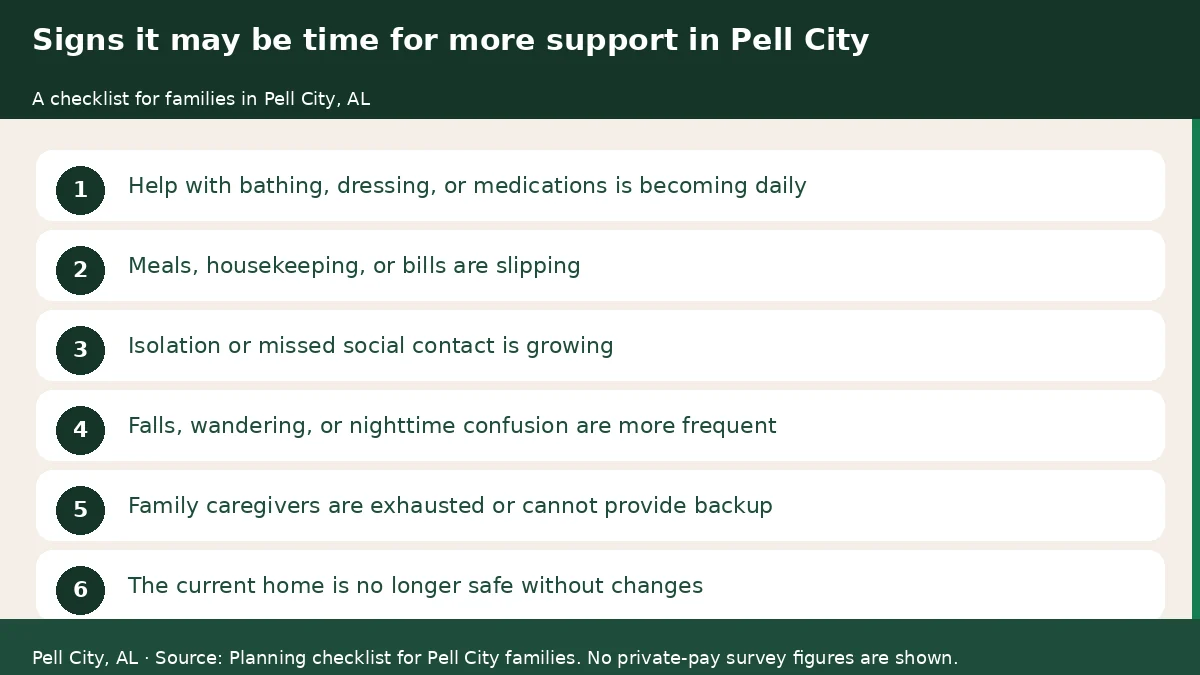
Start with the ordinary tasks that keep a household running. A parent may still insist that everything is fine while quietly doing less, avoiding difficult chores or relying on a spouse for tasks once handled independently.
- Clothing is soiled, inappropriate for the weather or worn repeatedly because dressing and laundry have become difficult.
- The refrigerator contains little fresh food, meals are skipped, or preparing food has become confusing or physically tiring.
- Clutter, unpaid bills or neglected cleaning represent a change from the person’s usual standards.
- Bathing, using the bathroom or moving around the home requires more effort, hesitation or hands-on help.
- A once-active parent rarely leaves home, declines invitations or seems lonely even when family members call regularly.
Medication routines also deserve careful observation. Unopened packages, mixed-up organizers or uncertainty about whether a dose was taken can show that the routine is no longer manageable. Families should record what they observe without changing doses or guessing at a diagnosis. Those notes can support a more useful conversation with the appropriate professional.
Safety risks and isolation deserve equal weight
Physical safety is often the clearest concern. Look for new bruises without a clear explanation, difficulty rising from a chair, trouble managing steps, or a stove repeatedly left on. Consider the layout of the home as well as the person’s abilities. A house that worked well for years may now demand more reaching, climbing or walking than is comfortable.
Emotional well-being matters too. An older adult can be physically safe and still spend most days without meaningful company. Hearing loss, giving up driving or the death of friends may gradually shrink a person’s world. In Pell City and nearby Cook Springs, distance from family can make that isolation less visible. Assisted living is worth discussing when supervision and daily help are needed, but also when a person would benefit from a more connected environment.
Caregiver strain is a sign, not a failure
A spouse who is exhausted while lifting, bathing or constantly checking on a partner may be providing more care than is sustainable. Adult children may notice that work, sleep and their own households are being squeezed by repeated trips and late-night worries. These facts belong in the decision. Love does not make unlimited energy, training or backup support available.
Respite care can create room to think. The National Institute on Aging’s overview of respite care explains that it may take place at home, in an adult day center or through a short residential stay. If a suitable stay is available, it can give the caregiver a break and let the older adult experience a different routine without treating the visit as a permanent commitment.
How to start the conversation without taking over
Choose a calm time, not the middle of an argument or immediately after a frightening incident. Speak about specific observations and your own concern rather than delivering a verdict. “I’ve noticed that cooking has become difficult, and I worry about you being alone” leaves more room for discussion than “You can’t live here anymore.”
- Ask what feels hardest at home and what your parent would most like to preserve.
- Describe two or three observed changes, using plain language and avoiding labels.
- Offer to gather information together before asking for a decision.
- Agree on the next small step, such as a visit, a budget review or another family conversation.
A parent’s preferences should remain visible throughout the process, even when adult children are helping with logistics. Learning about assisted living in Pell City can be framed as gathering options, not forcing a move. If the person can participate, include them in questions about routines, privacy, location and the kind of daily support they would accept.
What assisted living and memory care support can mean
Village East, at 220 Kings Circle in Pell City, offers assisted living and memory care. Its St. Clair County location is east of Birmingham on Interstate 20, which may matter to families traveling from Moody, Leeds or other parts of the Birmingham area. A visit should focus on actual routines: how help is requested, how changes are communicated and what daily life looks like to a resident.
Assisted living and memory care are not interchangeable descriptions. Alabama licenses assisted living facilities and separately licenses Specialty Care Assisted Living Facilities for residents with cognitive impairment, as explained by the Alabama Department of Public Health’s facility descriptions. When considering memory care, ask about the setting, supervision and support provided. It should not be presented as a way to cure dementia or guarantee a particular outcome.
What Birmingham-area cost figures mean for Pell City planning
Pell City is in St. A regional median is a planning benchmark, not a quote for Village East or any other community.
That comparison does not make the settings interchangeable: the amount and timing of help, household expenses and the availability of family caregivers all affect what is practical. Continuous home coverage is particularly different from a few scheduled visits.
These comparisons describe broad markets, not the price or value of an individual Pell City apartment.
Use the numbers to frame questions about a budget and the level of support required. Ask what any quoted rate includes and how changes in support could affect it. For current Village East rates, call the community directly.
Payment sources require careful verification
Medicare should not be treated as a general plan for paying assisted living costs. Medicare’s long-term care coverage guidance states that it does not cover long-term custodial care when that is the only care needed, and most long-term care is custodial. Other insurance or health benefits should be reviewed separately rather than assumed to fill that gap.
Alabama Medicaid’s Elderly and Disabled Waiver covers specified home and community-based services for eligible people who meet nursing facility level-of-care requirements. The Alabama Medicaid waiver description also makes clear that it does not pay for assisted living room, board or assisted living services. Most Alabama families pay privately for assisted living.
An existing long-term care insurance policy may help, depending on its terms. The Administration for Community Living’s insurance explanation notes that benefits commonly depend on an elimination period and needs involving daily activities or cognitive impairment. Read the actual policy, ask how claims are documented and confirm which settings and charges qualify.
For wartime-era Veterans and surviving spouses, VA Aid and Attendance may increase a VA pension when eligibility requirements are met. The current VA pension rates list an annual Maximum Annual Pension Rate of $29,093 for a Veteran with no dependents, equivalent to a maximum monthly pension of $2,424 if countable income were zero.
The VA net worth limit from December 1, 2025 through November 30, 2026 is $163,699. Pension calculations consider countable income, and qualifying unreimbursed medical expenses can affect that calculation. Asset-transfer reviews and penalties may also apply. These figures are not an estimate of what a particular Pell City family will receive, so eligibility and timing should be confirmed before they are included in a care budget.
A measured next step for Pell City families
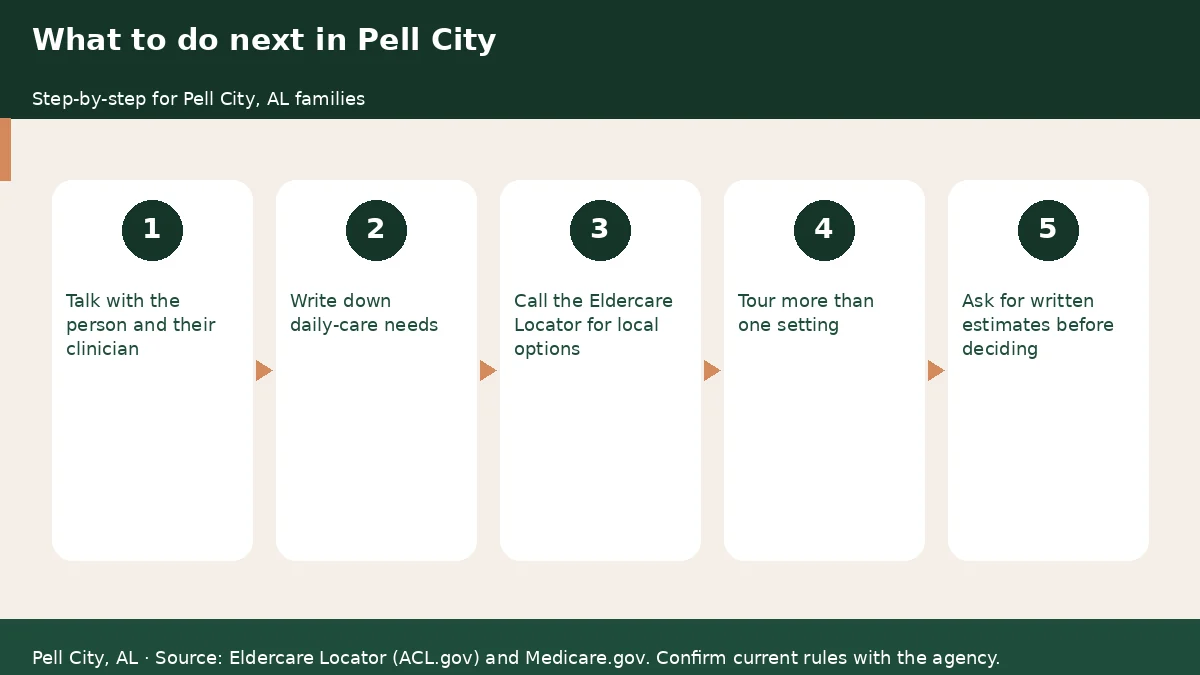
A useful family plan brings the observations together: what is happening at home, which tasks require help, whether the caregiver can continue safely, and what monthly resources are available. The Eldercare Locator from the U.S. Administration for Community Living can connect families with local aging services through Area Agencies on Aging. That can be a starting point for learning about support beyond a single residential option.
The signs it's time for assisted living are most helpful when they lead to a clearer conversation rather than a rushed conclusion. A parent’s wishes, the caregiver’s limits and the realities of the home all deserve a place in the decision. Taking time to observe, ask and compare can preserve dignity while making safety concerns harder to overlook.
Frequently asked questions
What are practical signs it may be time for assisted living in Pell City?
Look for a pattern rather than one difficult day. Concerns may include unsafe cooking, increasing trouble with bathing or mobility, neglected food and housekeeping, medication confusion, growing isolation, or a spouse who is exhausted by caregiving. Write down specific examples and whether they keep happening. A change from your parent’s usual abilities is often more useful than comparing them with someone else.
Does the Birmingham cost median show what assisted living in Pell City will cost?
No. A median describes a broad market and is not a community quote. Apartment terms, included support and rate changes need individual review. Families should call Village East for current rates and ask exactly what any quoted monthly charge includes.
Will Medicare or Alabama Medicaid usually pay for assisted living?
Medicare generally does not cover long-term custodial care when that is the only care needed. Alabama Medicaid’s Elderly and Disabled Waiver covers specified home and community-based services for eligible people, but it does not pay assisted living room, board or assisted living services. Most Alabama families pay privately for assisted living. Existing long-term care insurance and possible Veterans benefits should be reviewed individually.
Can a respite stay help a Pell City family decide?
A short respite stay can give a caregiver a break and let an older adult experience meals, routines and support in a residential setting. It should not be treated as a guarantee that a permanent move will feel the same. Ask Village East whether a short-term arrangement is available, what it would include and how preferences are handled. Keep the older adult involved in planning and discussing the experience.
How should families compare assisted living and memory care at Village East?
Begin with the support the person actually needs. Assisted living may be considered when daily tasks and household management require help. Memory care should be discussed in terms of supervision, support and environment for someone with cognitive impairment, not promised outcomes. Village East offers both types of care. Families can ask which Alabama license applies, how needs are reviewed and how changes are communicated.
Talk with Village East
If you are weighing care options in Pell City, call (205) 814-4200 or request a tour. Our team can talk through current availability, rates and next steps. Please confirm all details directly, since published figures and listings change over time.
Sources
- VA Aid and Attendance and Housebound benefits
- VA pension rates (current)
- Medicare: long-term care coverage
- Eldercare Locator (U.S. Administration for Community Living)
- National Institute on Aging: What is respite care?
- ACL: What is long-term care insurance
- Alabama Department of Public Health: Facility descriptions
- Alabama Medicaid: Elderly and Disabled Waiver
Program rules and benefit amounts were checked on the linked official pages in November 2026 and can change.
Related reading on this site: