Alabama Assisted Living Licensing and Regulations Explained
A plain-English guide to state licensing, dementia-care distinctions, complaints, costs and the questions worth asking before choosing a residence in Pell City.
Alabama assisted living regulations become easier to use when a family separates three questions: Is the residence licensed, which license does it hold, and does its daily support match the person who may live there? For adult children comparing options in Pell City, those questions are more useful than a polished brochure. They also give spouses a shared way to discuss care without reducing the decision to one tour or first impression.
The Alabama Department of Public Health licenses assisted living facilities and describes a separate category for certain dementia care. That distinction matters in St. Clair County, where a family may compare a residence in Pell City with options elsewhere in the Birmingham metro. Village East, at 220 Kings Circle, offers assisted living and memory care. Its services should be considered alongside the same licensing, inspection and payment questions used for any residence.
Alabama assisted living regulations and license types
The state’s facility descriptions identify assisted living facilities and, separately, Specialty Care Assisted Living Facilities, abbreviated SCALF. General assisted living facility rules are listed as Chapter 420-5-4. SCALF rules are listed as Chapter 420-5-20. These chapter numbers give families precise references when asking a community or the state which requirements apply; they are not extra credentials to infer from a marketing label.
A SCALF is an assisted living facility specially licensed and staffed to care for residents with cognitive impairment such as dementia. The word “specially” should prompt specific questions, not assumptions. Ask which license covers the area being considered, how staffing and supervision are organized, and what happens if needs change. Alabama assisted living regulations provide categories and rules; they do not remove the need to assess individual fit.
How to verify a current license in Pell City
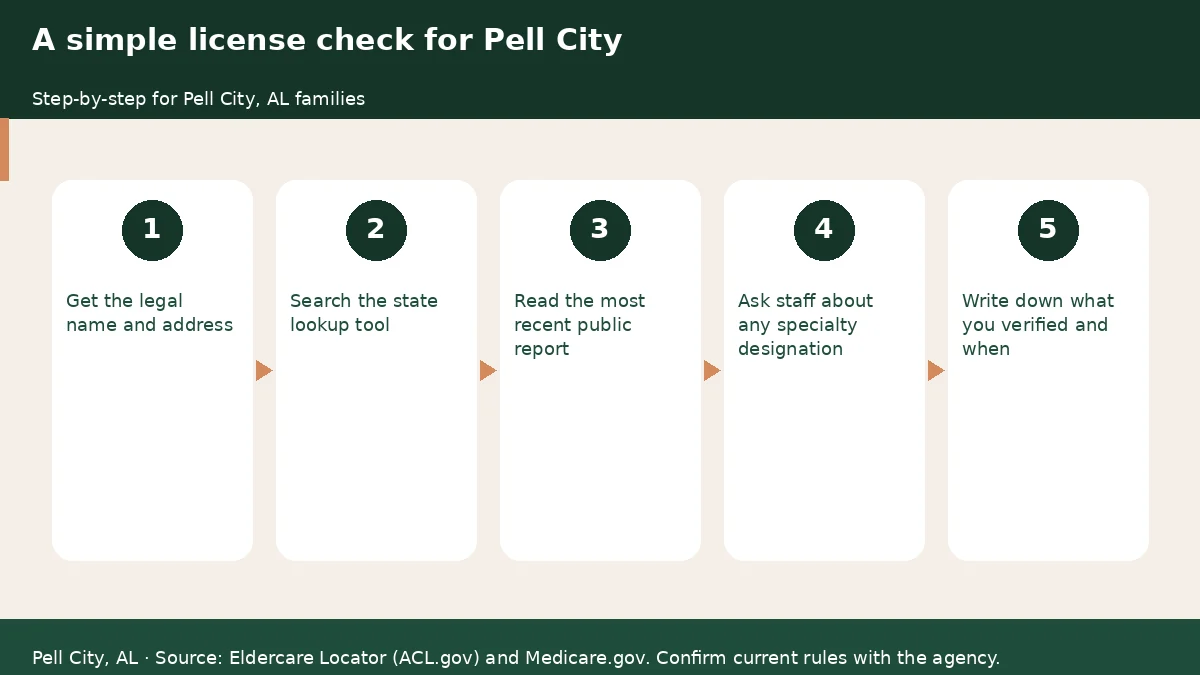
Begin with the exact name and street address on the current license, then match them to the building and the area where care would be provided. For a tour at 220 Kings Circle, ask to see the document rather than relying on a verbal statement that the community is licensed. If a corporate name, community name or address differs, ask for a plain explanation and verify it with the Department of Public Health.
Also ask which license category applies and whether more than one category is relevant to the services being discussed. Write down the expiration date and the name of the person answering. Clear records help siblings compare notes and give a spouse something concrete to revisit after an emotional day. If a document cannot be produced immediately, arrange a specific time to follow up rather than letting the question disappear.
What memory care and the SCALF distinction mean
Memory care is best discussed as support, supervision and environment for a person living with cognitive impairment. It should not be presented as a cure, a treatment result or a guarantee that symptoms will follow a predictable path. The practical question is whether the setting can provide the help needed now and how staff will respond as abilities, communication or routines change.
The SCALF description gives Pell City families a useful follow-up: if a residence offers dementia-specific care, ask whether the proposed placement is under that separate license and what specially licensed and staffed means in daily practice there. Request concrete explanations of supervision, supportive surroundings, personal care and family communication without assuming that any one feature is established by the label alone.
Readers can review Village East’s memory care information as a starting point, then confirm licensing and current services directly. Keep the person’s habits at the center: waking and sleeping patterns, food preferences, mobility, sources of distress, and the ways reassurance is usually offered. A diagnosis matters, but a workable day-to-day plan matters too.
Inspections, renewal dates and complaint channels
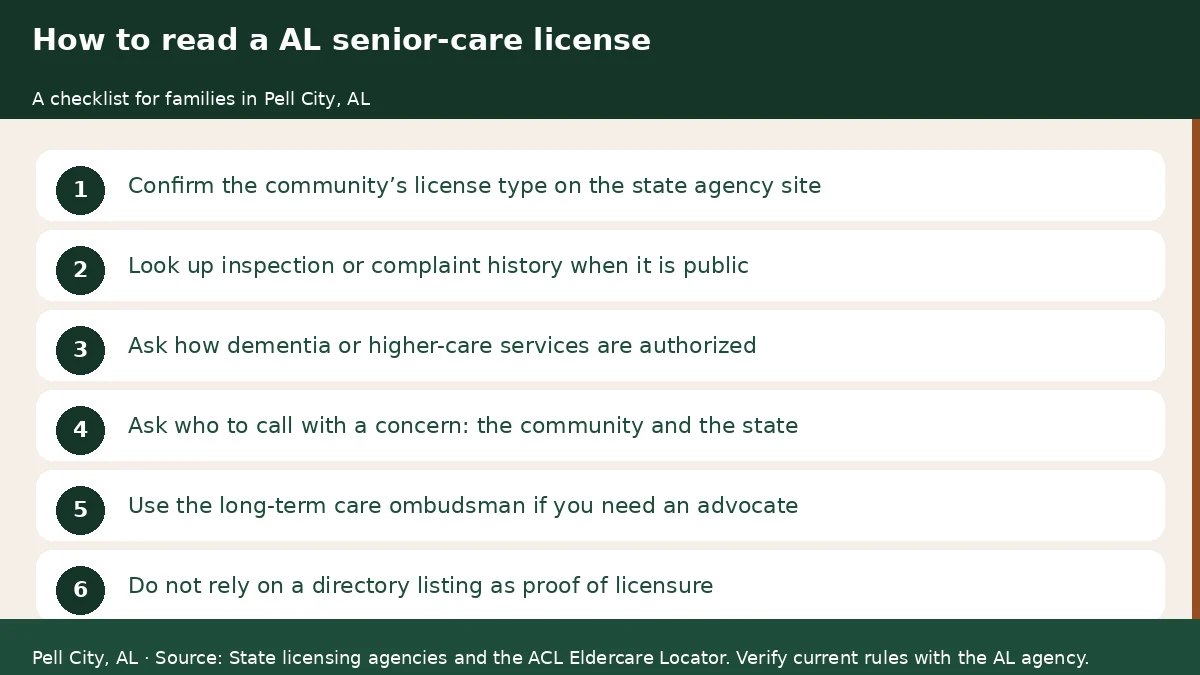
A license document, an inspection history and a complaint are three different things. State licenses expire December 31 and are renewed annually, but that administrative date is not a quality score. The state facility-description page explains license categories; it is not a Pell City inspection report. Ask to see the most recent state inspection or survey paperwork available, including cited deficiencies and documented corrections, and ask the department how to verify the regulatory history.
Do not infer an inspection frequency or whether a visit was announced from the annual renewal date. If that timing matters to your decision, ask the department about its current process. Likewise, an allegation is not the same as a substantiated finding. Read dates, outcomes and corrective actions carefully, and give the residence an opportunity to explain documents you do not understand.
For a concern that is not an immediate emergency, record what happened, when it happened, who was notified and what response followed. Raise it through the community’s management process and keep copies of communications. Families can use the Department of Public Health’s provider-standards resources to locate the current complaint route and ask what information to submit. Confirm that route directly rather than relying on an old brochure or unofficial directory. Urgent safety needs require immediate help, not simply a licensing complaint.
Questions to carry into a tour
Families learning about assisted living in Pell City can use the same short checklist at Village East or any other residence they are considering. Ask for written materials where available, and distinguish what is included now from what would require a different arrangement later.
- Which current license covers the building and the particular care area being proposed?
- How are needs involving bathing, dressing, eating, mobility and other daily activities assessed and reviewed?
- Who provides supervision during evenings, overnight hours and weekends, and whom does a family call with a concern?
- For cognitive impairment, how are supervision, daily routines, personal support and the physical environment organized?
- Can the community explain its latest available inspection documents and how family complaints are recorded and addressed?
- What services are included in the current rate, what may cost extra, and what happens if care needs increase?
Take notes immediately after the visit. Separate direct observations from impressions, and mark every answer that still needs documentation. Using Alabama assisted living regulations this way turns a broad subject into a manageable comparison without pretending that paperwork alone can determine whether a residence feels right.
How Birmingham-area costs fit the decision
Cost cannot tell you whether a license fits, but it can determine whether a plan is sustainable. Clair County. In the , based on data collected from July through November 2025, reported assisted living medians were:
These figures describe broad markets, not a quote for Village East or any other community. Call each residence for current rates, and ask what those rates include, possible additional charges and when charges can change.
Those settings involve different services and needs. Comparing prices without also comparing supervision, meals, home maintenance and family caregiving time can obscure important practical differences.
Medicare, Medicaid, VA and insurance
Payment rules need the same precision as licensing. Medicare’s long-term care guidance says it does not cover long-term custodial care when that is the only care needed, and most long-term care is custodial. Do not assume Medicare will cover an assisted living monthly bill.
Alabama Medicaid’s Elderly and Disabled Waiver covers specified home and community-based services for people who meet nursing facility level of care. These include personal care, homemaker services, adult day health, respite and other listed supports. It does not pay for assisted living room, board or assisted living services. Most Alabama families pay privately for assisted living, so other benefits should be confirmed before an agreement is signed.
Some wartime-era Veterans or surviving spouses may qualify for an increased pension through VA Aid and Attendance. Current VA pension rates list a Maximum Annual Pension Rate with Aid and Attendance of $29,093 for a Veteran with no dependents and $34,488 for a Veteran with one dependent, effective December 1, 2025. The net worth limit from December 1, 2025 through November 30, 2026 is $163,699. These are not automatic flat payments: the pension calculation subtracts countable income, and certain unreimbursed medical expenses can affect that calculation.
Long-term care insurance may pay for assisted living, depending on the policy. Benefits usually begin after an elimination period and when the policyholder needs help with activities of daily living or has cognitive impairment. Read the actual policy and obtain written answers about benefit limits and waiting periods.
Use respite and keep the decision grounded
The National Institute on Aging describes respite care as a short-term break for family caregivers, arranged at home, through adult day centers or as short residential stays. For a Pell City family, that break can create room to gather documents and discuss observations without making a rushed commitment. The Eldercare Locator can also connect families with local Area Agencies on Aging for service guidance.
A useful decision file contains the current license, the applicable license category, available inspection records, plain payment answers and notes about the individual’s daily needs. Regulations establish the framework; careful observation and specific follow-up questions help a family use that framework with confidence.
Frequently asked questions
Who licenses assisted living facilities in Pell City, Alabama?
The Alabama Department of Public Health licenses assisted living facilities serving Pell City. General assisted living facility rules are listed in Chapter 420-5-4. Specialty Care Assisted Living Facilities are a separate category under Chapter 420-5-20 for residences specially licensed and staffed to care for people with cognitive impairment such as dementia. State licenses expire December 31 and are renewed annually. Ask to see the current license and verify its name, address and category.
Is memory care the same as a SCALF license in Alabama?
A memory care program name and a SCALF license are not interchangeable terms. Alabama describes a Specialty Care Assisted Living Facility as specially licensed and staffed for residents with cognitive impairment such as dementia. If you are considering memory care in Pell City, ask which license covers the exact area proposed for placement and how supervision, personal support and the environment work each day. No label guarantees an individual outcome.
How can I check inspections or complain about a Pell City residence?
Ask the residence for its most recent available state inspection or survey paperwork, including deficiencies and documented corrections. Contact the Alabama Department of Public Health through its current provider-standards resources to verify records and locate the complaint route. Keep dates, communications and copies of relevant documents. Remember that an allegation is not necessarily a substantiated finding, and do not infer an inspection schedule from the annual license-renewal date.
What does assisted living cost near Pell City?
Clair County. These are market medians, not Village East rates. Call the community for current pricing, included services and possible additional charges.
Will Medicare or Alabama Medicaid pay for assisted living in Pell City?
Medicare does not cover long-term custodial care when that is the only care needed. Alabama Medicaid’s Elderly and Disabled Waiver covers specified home and community-based services for people meeting nursing facility level of care, but it does not pay for assisted living room, board or assisted living services. Most Alabama families pay privately. Veterans benefits or long-term care insurance may help some households, depending on eligibility and the actual policy.
Talk with Village East
If you are weighing care options in Pell City, call (205) 814-4200 or request a tour. Our team can talk through current availability, rates and next steps. Please confirm all details directly, since published figures and listings change over time.
Sources
- VA Aid and Attendance and Housebound benefits
- VA pension rates (current)
- Medicare: long-term care coverage
- Eldercare Locator (U.S. Administration for Community Living)
- National Institute on Aging: What is respite care?
- ACL: What is long-term care insurance
- Alabama Department of Public Health: Facility descriptions
- Alabama Medicaid: Elderly and Disabled Waiver
Program rules and benefit amounts were checked on the linked official pages in November 2026 and can change.
Related reading on this site: