Assisted Living vs In-Home Care Costs in Pell City, AL
A practical look at Birmingham metro care costs, the hidden expenses of staying home, and questions Pell City families can use to compare support.
Pell City households often begin with the same budget problem: an older adult needs more help, but the right amount and setting are not yet clear. Comparing assisted living vs in-home care cost in Pell City, AL is more useful when the comparison includes weekly hours of help, the expenses of keeping a house running, and the time family members still provide. A single hourly rate or monthly median cannot answer all of that.
Clair County. The figures below are market medians or calculated scenarios, not prices for Village East or any other provider. They offer a steadier starting point than comparing a full residential monthly bill with only a few caregiver shifts.
What the Birmingham metro figures mean for Pell City
A median is a market midpoint, not a quote. It also does not show which services an individual community includes, charges separately, or adds after a care assessment.
Those comparisons describe broad markets; they do not predict the rate for a particular apartment, care plan, or Pell City household.
Assisted living vs in-home care cost in Pell City, AL, by weekly schedule
Monthly equivalents at 20 and 168 hours a week show how sharply the schedule changes the comparison.
The 20-hour and 168-hour amounts are calculated monthly equivalents using 52 weeks spread across 12 months. They are comparison scenarios, not provider quotes. That still is not a like-for-like comparison: the household remains responsible for its own living expenses, while the services included in a residential rate vary.
The 20-hour scenario may suit someone who needs limited, scheduled help, but it leaves substantial time without a paid caregiver. The 168-hour scenario represents around-the-clock coverage and does not describe a particular staffing arrangement. It shows why nights, weekends, backup coverage, and the ability to be safely alone must be identified before an hourly option is called more affordable.
The home expenses an hourly comparison leaves out
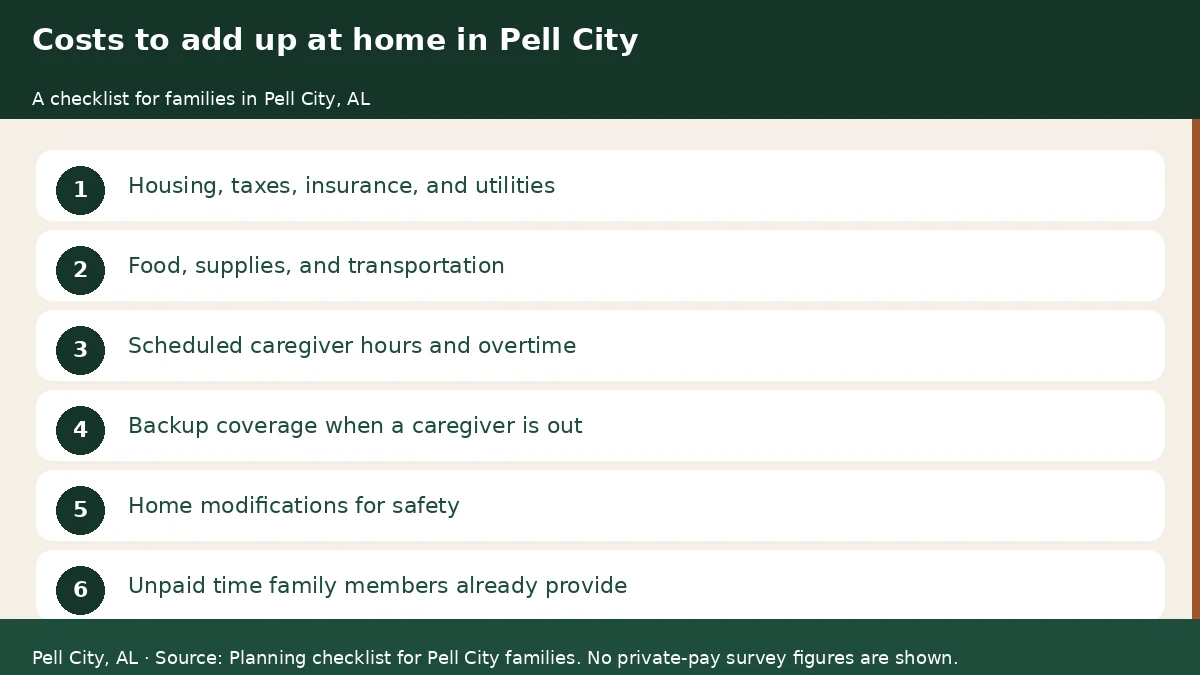
Staying home can preserve familiar routines, whether the house is in Pell City, near Cook Springs, or around Logan Martin Lake. The financial comparison should nevertheless include the whole household, not just caregiver invoices. Some expenses continue regardless of care setting, while others depend on the home and the person's needs.
- Home safety and property work: Grab bars, lighting, accessibility changes, repairs, cleaning, and yard work may require paid help or family time.
- Household living expenses: Food, utilities, insurance, property taxes, and routine supplies remain part of the budget at home.
- Transportation and errands: Appointments, groceries, prescriptions, and social outings may require a separate driver, additional caregiver hours, or family coordination.
- Family coverage: A spouse or an adult child traveling from Moody, Leeds, or Birmingham may fill gaps without sending an invoice, but that time still has practical limits.
Assisted living requires the same scrutiny. Ask for a written list of included services, additional charges, and circumstances that can change a rate. A lower invoice is not necessarily a lower total if it leaves essential expenses or unpaid coverage elsewhere.
Compare the support and setting, not just the bill
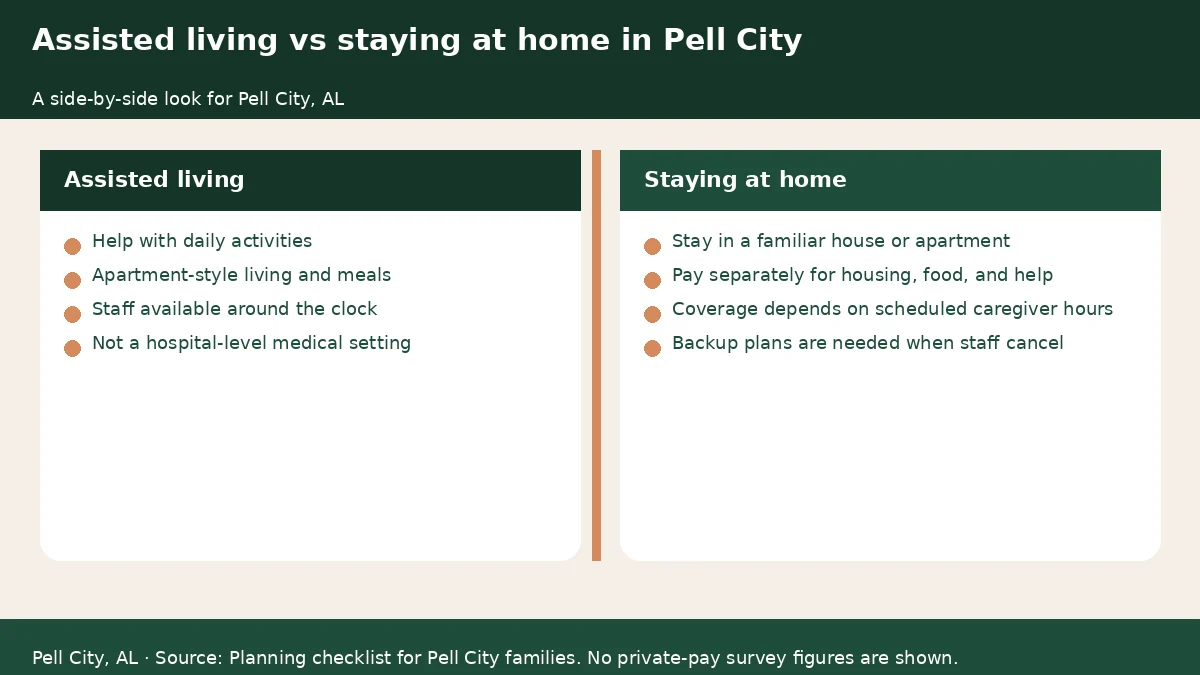
Support should match the person's actual day. Occasional help with dressing or meals is different from a need for continual supervision. Nighttime needs, mobility, medication routines, and a spouse's ability to provide reliable help all affect whether a limited home schedule is workable.
Village East is at 220 Kings Circle in Pell City, east of Birmingham on Interstate 20, and offers assisted living and memory care. Families can read about assisted living in Pell City and memory care, then ask how current needs are assessed and what each rate includes. For current Village East rates and availability, families can call (205) 814-4200.
When dementia is part of the decision, memory care should be discussed as support, supervision, and a structured environment, not as a promise to change the condition. The Alabama Department of Public Health's facility descriptions distinguish assisted living facilities from separately licensed Specialty Care Assisted Living Facilities, which are specially licensed and staffed for residents with cognitive impairment such as dementia. Ask any provider to explain its own license, staffing, supervision, and environment rather than inferring those details from a label.
Adult day care, respite, and nursing home benchmarks
Some families need a combination rather than a strict either-or choice. Adult day services may provide daytime structure and caregiver relief, but they do not replace overnight or continuous supervision. The National Institute on Aging explains respite care as a short-term break for family caregivers, provided at home, through adult day centers, or during short residential stays.
Nursing homes serve different needs, so the price gap alone is not a reason to choose or reject either setting.
Payment sources and their limits
Payment sources should be verified before they are entered into a care budget. Medicare's long-term care coverage guidance says Medicare does not cover long-term custodial care when that is the only care needed, and most long-term care is custodial. Ongoing help with daily activities should not be confused with separately covered medical services.
Long-term care insurance may pay for assisted living, depending on the policy. Benefits commonly depend on an elimination period and on needs involving daily activities or cognitive impairment. Read the actual policy and ask the insurer to confirm benefits, covered settings, and documentation requirements in writing.
Alabama Medicaid's Elderly and Disabled Waiver covers certain home and community-based services for eligible people who meet a nursing facility level of care. It does not pay for assisted living room, board, or assisted living services. Most Alabama families pay privately for assisted living.
VA Aid and Attendance
Aid and Attendance is an increase to a VA pension, not a stand-alone promise to pay a care provider. The VA's eligibility description includes wartime-era Veterans or surviving spouses who need help with daily activities, are bedridden, live in a nursing home because of lost abilities, or have limited eyesight. Other pension requirements also apply.
Effective December 1, 2025, current VA pension rates list a maximum annual pension rate with Aid and Attendance of $29,093 for a Veteran with no dependents and $34,488 for a Veteran with one dependent. The net worth limit from December 1, 2025, through November 30, 2026, is $163,699. A VA-accredited representative can review income, care expenses, and asset-transfer rules before a family relies on a possible amount.
A Pell City family's comparison worksheet
- Write down the help needed during mornings, afternoons, evenings, nights, and weekends.
- Price the actual home care schedule, including holidays, backup coverage, and minimum shift requirements.
- Request residential rate sheets and identify included services, additional care charges, and rate-change policies.
- List remaining household expenses and the family time required under each option.
- Confirm insurance or public benefits before counting them as available income.
The Eldercare Locator, a service of the U.S. Administration for Community Living, connects families with local Area Agencies on Aging at 1-800-677-1116. It can help identify additional aging services without treating one program as a solution for every expense.
A sound assisted living vs in-home care cost comparison for Pell City is ultimately about sustainability. The better budget accounts for the help required, the people available to provide it, and the full cost of each setting over time.
Frequently asked questions
Is assisted living always more expensive than in-home care in Pell City?
Not on every schedule. The comparison changes when groceries, utilities, home upkeep, transportation, modifications, and unpaid family time are included. Pell City families should compare the actual hours needed, including nights and backup coverage, with written provider quotes and a complete household budget.
Does Medicare pay for assisted living or custodial home care in Pell City?
Medicare generally does not cover long-term custodial care when that is the only care needed. Families should not assume it will pay an ongoing assisted living bill or continuing help with bathing, dressing, and other daily activities at home. A separate, covered medical service may follow different rules. For a Pell City care plan, ask Medicare or a qualified benefits counselor to review the specific service rather than treating all home care as one category.
Can Alabama Medicaid pay for assisted living at Village East?
Alabama Medicaid's Elderly and Disabled Waiver does not pay for assisted living room, board, or assisted living services. It covers certain home and community-based services for eligible people who meet a nursing facility level of care. Most Alabama families pay privately for assisted living. Village East's payment options and current rates should be confirmed directly with the community; a waiver's existence should not be read as coverage or acceptance at any particular Pell City residence.
What should families ask about memory care in Pell City?
Village East offers memory care in Pell City, but families should still ask any provider to explain its specific license, staffing, supervision, daily routines, and environment. Alabama separately licenses assisted living facilities and Specialty Care Assisted Living Facilities for residents with cognitive impairment such as dementia. Ask how needs are assessed, how changes are communicated, and which services affect the monthly rate. Memory care should be compared as support and supervision, not as a promise of a medical outcome.
How does VA Aid and Attendance fit into a Pell City care budget?
Aid and Attendance can increase a VA pension for eligible wartime-era Veterans or surviving spouses who meet the applicable care and other requirements. It is not an automatic reimbursement for assisted living or home care. The amount depends on the applicable pension rate and countable income, and VA also applies net worth and asset-transfer rules. A Pell City family can have a VA-accredited representative review eligibility before treating any possible pension amount as available care income.
Talk with Village East
If you are weighing care options in Pell City, call (205) 814-4200 or request a tour. Our team can talk through current availability, rates and next steps. Please confirm all details directly, since published figures and listings change over time.
Sources
- VA Aid and Attendance and Housebound benefits
- VA pension rates (current)
- Medicare: long-term care coverage
- Eldercare Locator (U.S. Administration for Community Living)
- National Institute on Aging: What is respite care?
- ACL: What is long-term care insurance
- Alabama Department of Public Health: Facility descriptions
- Alabama Medicaid: Elderly and Disabled Waiver
Program rules and benefit amounts were checked on the linked official pages in November 2026 and can change.
Related reading on this site: