Ways to Pay for Assisted Living in Alabama: A Guide for Pell City Families
A practical guide to costs, benefits and coverage limits for families considering assisted living or memory care in Pell City.
Learning how to pay for assisted living in Alabama is easier when families separate the monthly cost of a community from the benefits that may help with care. For Pell City households, that means looking at income, savings and home equity first, then checking Medicaid, Veterans benefits, insurance and Medicare against their actual rules. A benefit can be valuable without covering room and board, and a care setting with a lower monthly figure may not include the same support.
Village East offers assisted living and memory care at 220 Kings Circle in Pell City, in St. Clair County, east of Birmingham on Interstate 20. The cost benchmarks below are for the Birmingham metro region used for Pell City. They are survey medians and listed rates, not a quote from Village East; families should call the community directly for current rates and included services.
Start with the Birmingham-area cost picture
The , based on data collected from July through November 2025, groups Pell City in the Birmingham metro region, which includes St. Clair County. Its figures provide a consistent starting point for comparing settings, although they do not show what any individual community charges or what a particular person will need.
These comparisons are useful for context, but a family’s actual budget should be based on written quotes with the same services and fee assumptions.
Other settings help frame the budget, but they are not interchangeable. A home-care figure alone does not include every housing, meal, maintenance or supervision expense a household may still have.
Those comparisons describe price levels, not the right level of care for any person. Adult day health care also serves a different purpose from residential care. Ask what each quoted rate includes and which needs would require a different setting.
How to pay for assisted living in Alabama with private funds
Private pay usually starts with a monthly cash-flow statement. List Social Security, pensions and other dependable income, then consider savings and investment assets separately so the family can see how long reserves might last under different scenarios. Include the cost of maintaining a house until it is sold or occupied. When comparing assisted living in Pell City, request a written schedule of current charges, services included, possible additional care fees, deposit terms and the process for rate changes.
Home equity can provide another source of funds, but selling, renting and borrowing are different decisions. A sale may simplify upkeep but involves transaction costs and timing. Renting creates management and tax questions, while a loan creates repayment obligations. Do not assume a home will sell quickly or for a particular amount. A tax professional, fiduciary financial adviser or elder-law attorney can help evaluate consequences before documents are signed, especially when benefit rules include asset-transfer reviews.
If relatives plan to share costs, put the arrangement in writing. Clarify who pays which bill, how records will be kept and what happens if circumstances change. Avoid building the plan around an unapproved VA claim, an expected insurance payment or a future home sale. A conservative plan distinguishes money available now from money that may arrive later.
Alabama Medicaid and the Elderly and Disabled Waiver
Alabama Medicaid’s Elderly and Disabled Waiver covers specified home and community-based services for people who meet nursing facility level of care. Listed services include case management, personal care, homemaker services, adult day health, respite, companion services and home-delivered meals. Meeting that level of care is not a reason to assume every other eligibility rule is satisfied; ask Alabama Medicaid about current financial and application requirements.
The waiver does not pay for assisted living room, board or assisted living services, and most Alabama families pay privately for assisted living. It should therefore not be presented as a way to cover Village East’s monthly bill. Its adult day health or respite benefits, when a person is eligible and enrolled, do not change that room-and-board rule.
Because enrollment and waiting-list status can change, Pell City families should ask whether applications are being accepted, whether a waiting list is in effect, how level of care is assessed and which services are available in St. Clair County. Record the date, the name of the office and the next step. Do not transfer or spend assets based on a general description of Medicaid; obtain advice about the person’s complete circumstances.
VA Aid and Attendance for eligible Veterans and surviving spouses
VA Aid and Attendance is an increased monthly amount added to a VA pension, not a universal assisted living grant. It is intended for eligible wartime-era Veterans or surviving spouses in circumstances that include needing help with daily activities such as bathing, dressing or eating, being bedridden, living in a nursing home because of lost abilities, or having limited eyesight. VA determines service, pension and other eligibility; living in assisted living alone does not establish a claim.
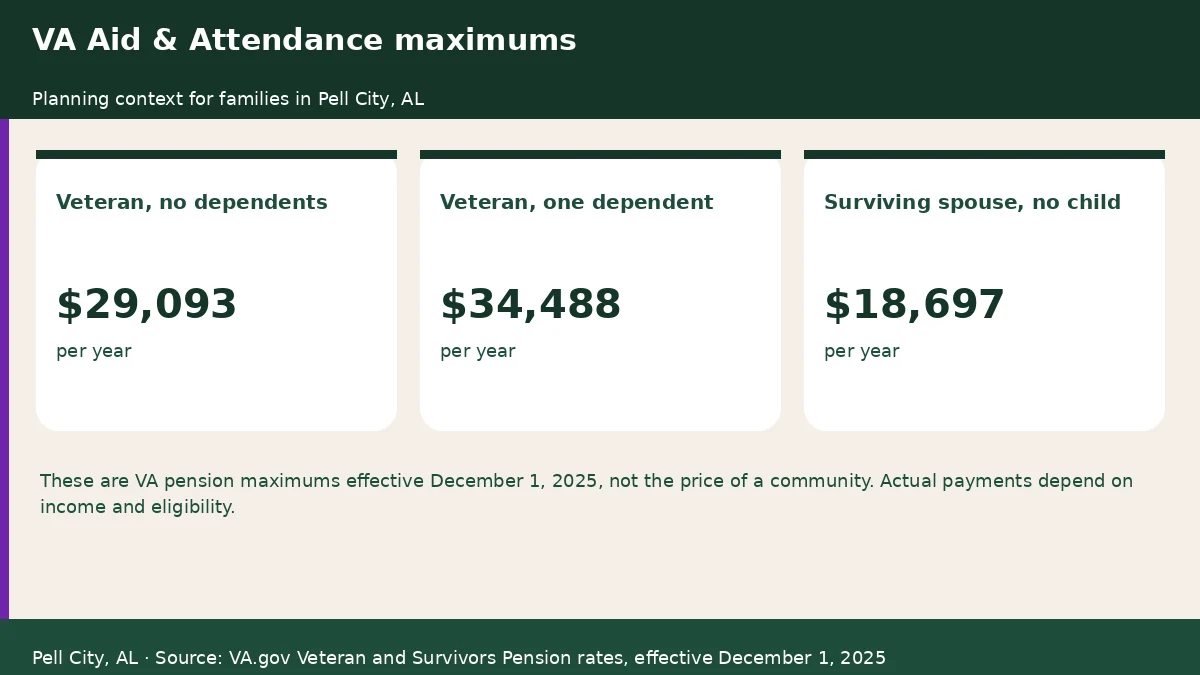
Under the current VA pension rates, effective December 1, 2025, the Maximum Annual Pension Rate with Aid and Attendance is $29,093 for a Veteran with no dependents and $34,488 for a Veteran with one dependent. They are maximum rates, not promises of an award or amounts automatically added to every existing payment. The pension calculation is the applicable maximum rate minus countable income.
The VA net worth limit from December 1, 2025 through November 30, 2026 is $163,699. VA reviews asset transfers during the three years before a claim, and a penalty period can last up to five years. Unreimbursed medical expenses above 5% of the applicable maximum rate, which can include care costs, may reduce countable income. Keep care invoices and receipts, and ask VA or an accredited representative how they should be documented. Do not move assets simply to chase eligibility without qualified advice.
Review long-term care insurance before counting on it
Long-term care insurance can pay for services such as assisted living, depending on the policy. Benefits usually begin after an elimination period and when the policyholder needs help with activities of daily living or has cognitive impairment. Before including a policy in the budget, ask the insurer whether the intended setting is covered, what triggers benefits, how the elimination period is counted, and what daily or monthly maximums and benefit periods apply.
Also ask about exclusions, required provider qualifications, claim forms, care-plan reviews and whether premiums change during a claim. Read the policy itself rather than relying on a brochure or memory. If cognitive impairment is part of the decision, compare the policy language with the support, supervision and environment sought through memory care; insurance is a funding mechanism, not a description of care. Confirm directly with Village East how any billing or reimbursement paperwork would be handled.
Understand Medicare’s limits
Medicare’s long-term care guidance says Medicare does not cover long-term care, described as custodial care, if that is the only care needed. Most long-term care is custodial. Ongoing help with daily activities or supervision should therefore not be budgeted as though Medicare will pay an indefinite assisted living bill.
A separate, limited covered service should not be confused with coverage of an entire residential stay. Ask the relevant provider and insurer exactly what is covered, for how long and under what conditions, and request written information when possible. Keep any answer about a specific health benefit separate from questions about rent, meals, personal care and monthly community charges.
Find free guidance and build a written backup plan
The Eldercare Locator, a service of the U.S. Administration for Community Living, connects families with local Area Agencies on Aging. Pell City families can call 1-800-677-1116 and ask which agency serves their address. Useful questions include whether benefits counseling is available, who can explain the Elderly and Disabled Waiver, what caregiver support is offered and where current waiting-list information can be obtained. Confirm which services are free and whether eligibility rules apply.
Respite can also create room to plan. The National Institute on Aging describes respite care as a short-term break for family caregivers, provided in the home, at adult day centers or through short residential stays. It is not an ongoing source of payment. Ask about availability, charges, minimum stay requirements and whether the setting can meet the person’s needs. The the National Institute on Aging also operates a 24/7 Helpline at 1-800-272-3900 for dementia-related support.
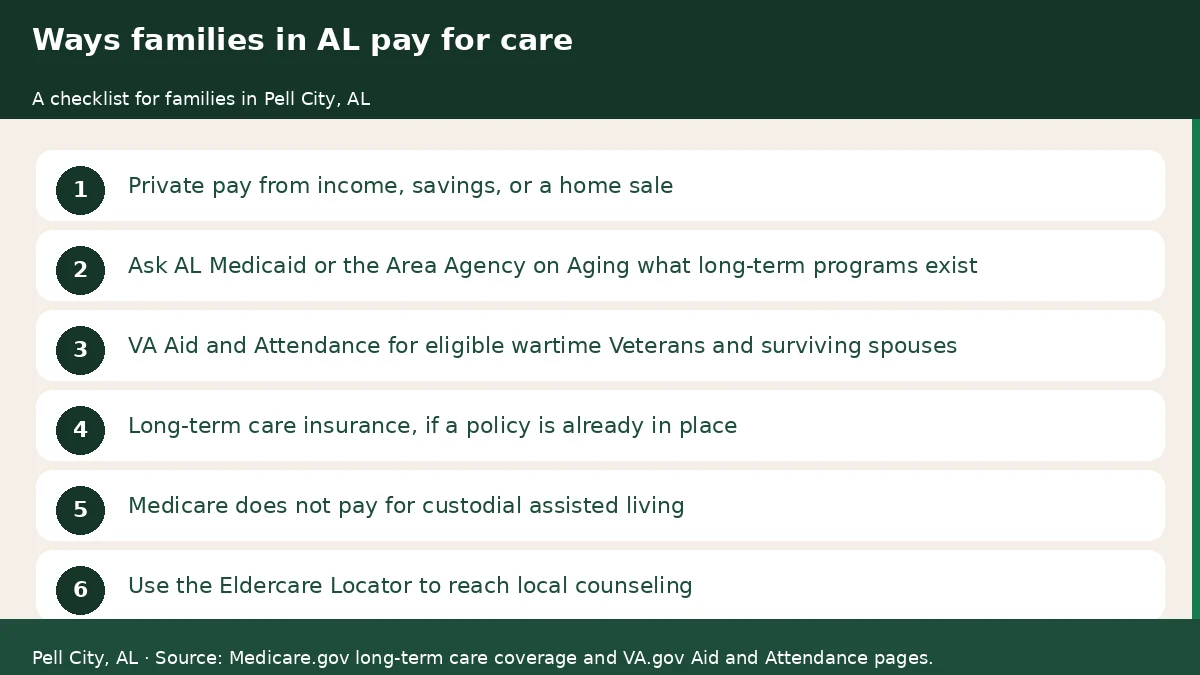
Before committing to a funding route, assemble monthly income statements, asset records, insurance policies, military discharge documents if applicable, and a current list of care needs. Bring the same questions to each community and benefits office. Ask what is included, how changing needs are reviewed, who files claims and what happens if funds become limited. The answer to how to pay for assisted living in Alabama is often a documented combination of resources, with realistic contingencies rather than assumptions.
Frequently asked questions
Does Alabama Medicaid pay for assisted living in Pell City?
Alabama Medicaid’s Elderly and Disabled Waiver covers listed home and community-based services for people who meet nursing facility level of care and satisfy other eligibility rules. It does not pay for assisted living room, board or assisted living services, and most Alabama families pay privately. Pell City families should ask Alabama Medicaid or their local Area Agency on Aging about financial criteria, applications, service availability in St. Clair County and whether a waiting list is currently in effect.
What does assisted living cost near Pell City?
Pell City is grouped in that metro region, which includes St. Clair County. These are benchmarks, not Village East prices. Call the community for its current rate, and ask what is included, whether additional care can change charges and how future rate changes are communicated.
Can VA Aid and Attendance cover an assisted living bill?
VA Aid and Attendance is an increase to a VA pension for eligible wartime-era Veterans and certain surviving spouses, not an automatic assisted living benefit. Effective December 1, 2025, the maximum annual pension rate is $29,093 for a Veteran with no dependents and $34,488 for a Veteran with one dependent. Countable income affects the pension, and other eligibility rules apply. Pell City families should confirm service, income and asset details with VA before relying on an award.
Will Medicare pay for memory care in Pell City?
Medicare does not cover long-term custodial care if that is the only care needed, and most long-term care is custodial. Pell City families should not assume Medicare will pay an ongoing assisted living or memory care monthly bill. Memory care should be understood as support, supervision and environment rather than a promise of a health outcome. Ask Medicare or another insurer about any specific limited benefit, separately from the community’s residency charges.
Where can Pell City caregivers get free planning help?
Start with the Eldercare Locator at 1-800-677-1116 and ask for the Area Agency on Aging serving your Pell City address. Ask about benefits counseling, caregiver support, the Elderly and Disabled Waiver and current waiting-list information; confirm which services are free and whether eligibility applies. For dementia-related support, the the National Institute on Aging operates a 24/7 Helpline at 1-800-272-3900. Neither service should be treated as a promise of funding or an immediate opening.
Talk with Village East
If you are weighing care options in Pell City, call (205) 814-4200 or request a tour. Our team can talk through current availability, rates and next steps. Please confirm all details directly, since published figures and listings change over time.
Sources
- VA Aid and Attendance and Housebound benefits
- VA pension rates (current)
- Medicare: long-term care coverage
- Eldercare Locator (U.S. Administration for Community Living)
- National Institute on Aging: What is respite care?
- the National Institute on Aging: respite care
- ACL: What is long-term care insurance
- Alabama Medicaid: Elderly and Disabled Waiver
Program rules and benefit amounts were checked on the linked official pages in November 2026 and can change.
Related reading on this site: