Cost of Memory Care in Pell City, AL: What Families Should Budget
A practical guide to Birmingham-area benchmarks, memory care pricing, Alabama licensing, and payment options for families planning care in Pell City.
For a family in Pell City, a useful budget begins with a clear description of the support needed, not a single advertised number. The cost of memory care in Pell City AL can reflect supervision during the day and overnight, help with personal routines, the design of the living environment, and the way a community separates housing from care charges. A written quote should make those pieces visible and explain what happens if needs change.
This guide therefore uses the Birmingham assisted living median as a floor reference and Birmingham nursing home figures as an upper reference. They are planning markers, not a quote, a predicted memory care rate, or a suggestion that assisted living and nursing care are interchangeable. An actual memory care charge may fall outside these markers.
Benchmarks for the cost of memory care in Pell City AL
The , with data collected from July through November 2025, places Pell City in the Birmingham metro region, which includes St. Clair County. That makes the metro figures more useful for local planning than a statewide figure alone.
These comparisons describe broad markets; they do not establish what any Pell City community charges. The state figure is included so families can see how differently a statewide budget and a Birmingham-metro budget may look.
The nursing home figures provide an upper reference for a different, more clinical residential setting, not a cap on memory care pricing. Neither marker replaces an individualized quote. The useful next step is to identify what supervision and environment are being purchased.
Why memory care pricing can differ
Assisted living generally combines a place to live with meals and help with daily activities. Memory care is commonly organized around added supervision, a secured or more controlled environment, staff with dementia-specific training, and smaller group activities or dining arrangements. Those features can change staffing and building requirements. They describe support and structure; they do not cure dementia, stop its progression, or guarantee a particular response.
Families comparing assisted living in Pell City with memory care should describe the person’s current routine in concrete terms. A diagnosis alone does not show how much hands-on help is needed. Two people with the same diagnosis may need very different support with dressing, meals, mobility, medication routines, or finding their way safely.
- Note hands-on help needed with bathing, dressing, eating, toileting, or transfers.
- Describe supervision needs during the day, evening, and overnight.
- Explain exit-seeking, wayfinding, or other situations that affect door security.
- Ask about dementia training, activity group size, and responses to changes in routine.
A community can then explain which needs fit its base service and which require another care level. That explanation matters more than a label such as standard or enhanced, which may not mean the same thing elsewhere.
How pricing models affect the monthly bill
An all-inclusive model generally bundles housing and a defined package of care into one recurring charge. It can be easier to compare, but families still need to ask about limits, exclusions, and circumstances that trigger a new rate. A base-plus-care-level model starts with housing and basic services, then adds an amount tied to assessed needs. A lower base rate does not necessarily produce a lower total bill.
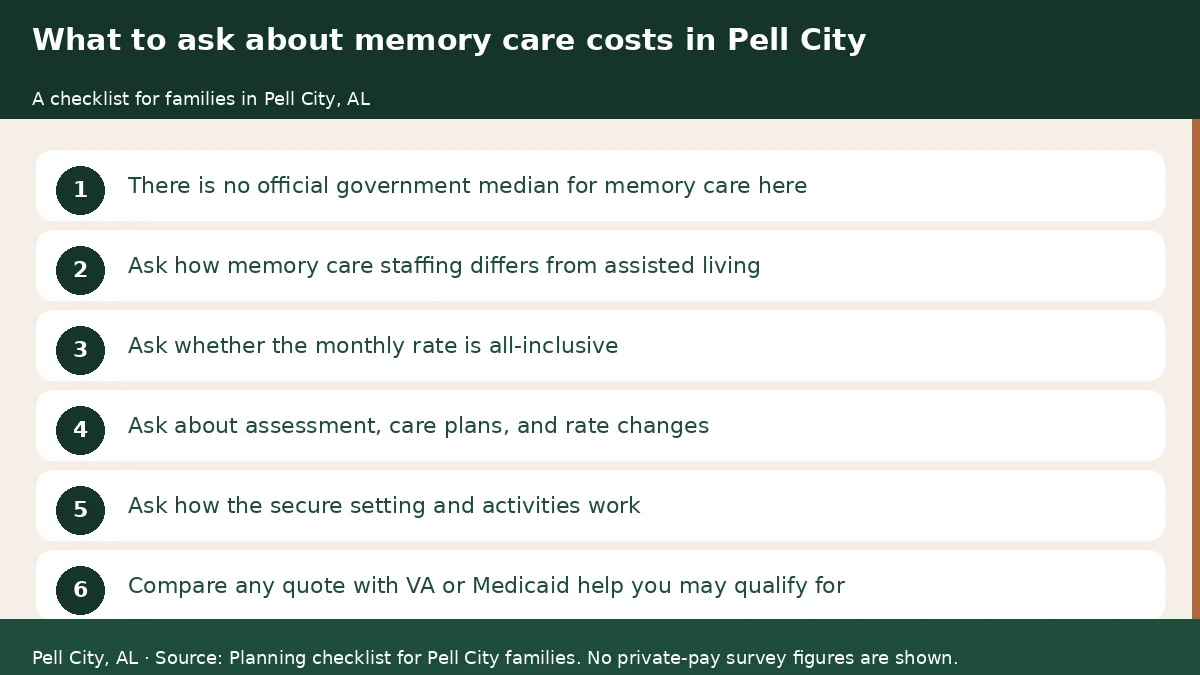
Ask for the same information from every provider so the comparison remains consistent:
- Which housing, meals, personal care, laundry, and supervision services are included?
- How is the initial care level assessed, and who completes that assessment?
- What needs or changes move a resident to another care level?
- How much notice accompanies a change in the care charge?
- Are medication support, supplies, transportation, or special diets billed separately?
- Which deposits or one-time fees apply, and are any refundable?
Village East offers assisted living and memory care at 220 Kings Circle in Pell City. No facility rates are stated here. For current rates and a written explanation of what its memory care charge includes, families can call (205) 814-4200. Ask whether the quote is all-inclusive or base-plus-care-level, how often assessments occur, and which changes require written notice. Request any one-time charges separately from recurring monthly charges.
Alabama licensing and dementia-care questions
The Alabama Department of Public Health’s facility descriptions explain that the state licenses assisted living facilities and, separately, Specialty Care Assisted Living Facilities. The latter are described as specially licensed and staffed to care for residents with cognitive impairment such as dementia. Licenses expire December 31 and are renewed annually.
Families should ask which license applies to the setting being offered, how dementia-specific staffing is organized, and what happens if a resident’s needs exceed what that setting can support. The phrase memory care in marketing material is not a substitute for those answers, and a community’s license type should not be inferred from its terminology. Licensing also does not reveal the monthly price, so the service discussion and cost discussion need to happen together.
Comparing support at home and adult day care
Some families weigh residential memory care against support assembled at home. The schedules marked as illustrations below use the Birmingham hourly rate; they are not published package prices.
That comparison still leaves out housing, food, utilities, home maintenance, and the time family members spend coordinating or covering unpaid hours. Adult day health care can be valuable during its operating hours, but it is not overnight residential supervision.
The around-the-clock illustration shows why continuous paid coverage can change the calculation quickly. It is not a quote for a live-in caregiver or an agency arrangement. For a person who needs frequent overnight supervision, families should identify exactly who is present, awake, and responsible during each part of the week before treating a home plan as sufficient.
Payment sources and their limits
Medicare
Medicare’s long-term care coverage guidance says Medicare does not cover long-term care, often called custodial care, when that is the only care needed, and notes that most long-term care is custodial. Families should separate medical coverage from the residential bill instead of assuming that a dementia diagnosis or hospital stay unlocks ongoing payment for room, board, personal care, and supervision.
Alabama Medicaid and long-term care insurance
Alabama Medicaid’s Elderly and Disabled Waiver covers listed home and community-based services for people who meet a nursing facility level of care. These include case management, personal care, homemaker services, adult day health, respite, companion services, and home-delivered meals. It does not pay for assisted living room, board, or assisted living services, and most Alabama families pay privately for assisted living.
Long-term care insurance may help, but the policy controls. The Administration for Community Living’s insurance overview explains that benefits can cover services such as assisted living, usually after an elimination period and when the policyholder needs help with daily activities or has cognitive impairment. Ask the insurer whether the proposed setting qualifies and what assessments, licenses, and records it requires.
VA Aid and Attendance
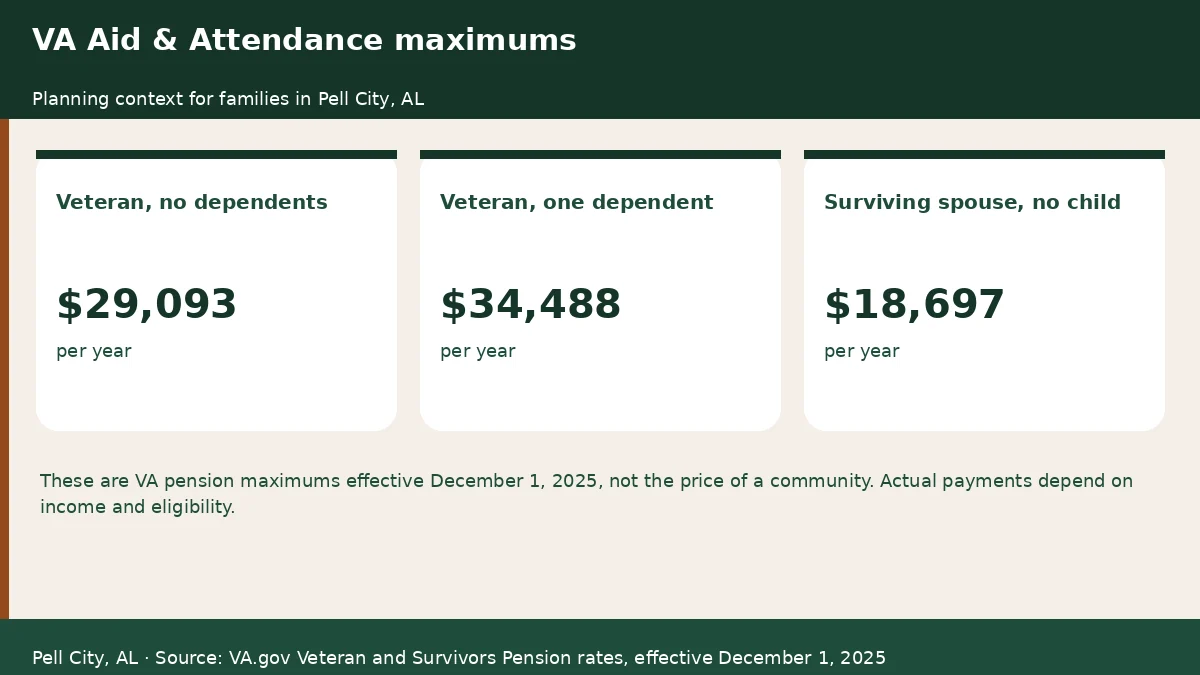
VA Aid and Attendance is an increased amount added to a VA pension for eligible wartime-era Veterans or surviving spouses who need help with daily activities or meet other criteria. The current VA pension rates list a Maximum Annual Pension Rate with Aid and Attendance of $29,093 for a Veteran with no dependents and $34,488 for a Veteran with one dependent, effective December 1, 2025.
They are maximum calculations, not automatic payments. The net worth limit from December 1, 2025 through November 30, 2026 is $163,699. Pension generally equals the maximum rate minus countable income, and certain unreimbursed care expenses can affect that calculation. Asset transfers can prompt review and penalties, so qualified advice is important before moving assets.
A steady planning process for Pell City families
Start with one typical day and one typical night, including the tasks that require another person nearby. Then make the financial comparison using the same description of needs.
- Write down the help used now and the help that is unreliable or missing.
- Request an assessment and an itemized quote based on that description.
- Compare recurring charges, possible care-level changes, and one-time charges separately.
- Identify who will review the arrangement if mobility or nighttime supervision needs change.
A short period of respite may also clarify logistics. The National Institute on Aging’s respite care explanation describes short-term breaks for family caregivers through in-home help, adult day centers, or short residential stays. For additional local guidance, the Eldercare Locator connects families with Area Agencies on Aging at 1-800-677-1116.
A careful estimate of the cost of memory care in Pell City AL combines current needs, local benchmarks, and written answers about services and rate changes. The goal is to understand the supervision, environment, and monthly obligations before a crisis narrows the choices.
Frequently asked questions
Is there an official monthly median for memory care in Pell City?
Families can use the Birmingham assisted living median as a floor reference and the Birmingham nursing home figures as an upper reference, while recognizing that these are different types of care. The bracket is only a planning tool. A current written quote based on an individual assessment is needed to understand an actual memory care charge.
Why does a Pell City memory care budget use Birmingham cost figures?
Clair County. The Birmingham figures are therefore the local market benchmark used here. Alabama statewide assisted living figures are included for context, but they are much lower than the metro median. Neither set of figures is a Village East rate or a guaranteed price for memory care.
Does Medicare pay for memory care in Pell City?
Medicare does not cover long-term custodial care when that is the only care needed, and most long-term care is custodial. That means families should not expect Medicare to pay an ongoing residential memory care bill simply because supervision and help with daily activities are needed. Medical coverage and payment for housing, meals, personal care, and supervision should be reviewed as separate issues before making a budget.
Will Alabama Medicaid’s Elderly and Disabled Waiver cover memory care?
The waiver covers certain home and community-based services for eligible people who meet a nursing facility level of care, including personal care, adult day health, respite, and case management. It does not pay for assisted living room, board, or assisted living services. Most Alabama families pay privately for assisted living. Ask Alabama Medicaid and the provider how the rules apply to the specific setting rather than assuming the waiver will cover memory care charges.
What should families ask Village East about memory care pricing?
Ask whether pricing is all-inclusive or uses a base rate plus care levels, what the current assessment includes, and which services or supplies cost extra. Request recurring and one-time charges separately, along with the process for reassessment and notice of a rate change. Also ask how supervision, secured-environment features, staff training, and group sizes are described. Village East’s current rates must be obtained directly by calling (205) 814-4200.
Talk with Village East
If you are weighing care options in Pell City, call (205) 814-4200 or request a tour. Our team can talk through current availability, rates and next steps. Please confirm all details directly, since published figures and listings change over time.
Sources
- VA Aid and Attendance and Housebound benefits
- VA pension rates (current)
- Medicare: long-term care coverage
- Eldercare Locator (U.S. Administration for Community Living)
- National Institute on Aging: What is respite care?
- ACL: What is long-term care insurance
- Alabama Department of Public Health: Facility descriptions
- Alabama Medicaid: Elderly and Disabled Waiver
Program rules and benefit amounts were checked on the linked official pages in November 2026 and can change.