Respite Care in Pell City, AL: Short-Term Support for Family Caregivers
A practical guide to short-term caregiver relief, local cost benchmarks, coverage limits, and preparation for a brief residential stay in Pell City.
For families researching respite care in Pell City AL, the immediate question is often simple: who can safely stay with an older adult while the usual caregiver rests, works, travels or attends to health needs? A useful answer starts with the hours and tasks involved, not with an assumption that one setting fits everyone. Pell City families can compare help at home, adult day health care and short residential stays, then check availability, coverage and total cost before making plans.
What respite care means for a family caregiver
The National Institute on Aging describes respite care as short-term relief for family caregivers. It can take place at home, in an adult day center or during a short stay in a residential setting. The essential feature is temporary coverage: someone else handles agreed care and supervision while the regular caregiver steps away. Respite may be planned for a recurring break or used during a caregiver’s illness, travel or an unusually demanding week. It is not a commitment to permanent placement, and it does not need to lead to one.
For a person living with dementia, the conversation should stay practical. Ask about personal care, supervision, communication, familiar routines and the physical environment. Memory care is support within that environment, not a promise to improve memory or change the course of a condition. The the National Institute on Aging’s respite guidance is another useful starting point for caregivers considering a break.
Options for respite care in Pell City AL
The right format depends on the older adult’s needs and the caregiver’s reason for stepping away. A family in Cook Springs or near Logan Martin Lake may want help without disrupting routines at home. A caregiver commuting toward Birmingham on Interstate 20 may need dependable daytime coverage. Someone recovering from exhaustion may need overnight supervision rather than a few isolated visits.
- In-home respite. A paid caregiver or another suitable helper comes to the home for an agreed schedule. Ask about bathing, dressing, meals, mobility assistance, companionship and overnight supervision. Confirm minimum shifts, cancellation terms, backup coverage and whether the caregiver may leave the person alone during any part of the visit.
- Adult day health care. The older adult attends a daytime program and returns home afterward. Confirm operating days, transportation, meals, personal care and whether the program can appropriately support cognitive impairment. Ask how supervision works throughout the day.
- A short residential stay. This can provide overnight coverage in a care setting, but availability and included services vary. Ask about the room, meals, laundry, medication support, accessibility, visiting and discharge timing. Request a written description of the stay, including what happens if care needs change or the setting cannot safely meet them.
Village East is located at 220 Kings Circle in Pell City and offers assisted living and memory care. Those services do not, by themselves, establish that respite stays are available. When you call, ask specifically about short stays, possible lengths, current rates and the needs that can be supported. The pages on assisted living in Pell City and memory care can help you frame questions about ongoing care as well, but do not assume that every ongoing service applies to a brief stay.
Building a respite budget from Birmingham-area figures
Clair County.
These are reference points, not provider quotes. Before comparing them, write down the exact hours of coverage you need and ask each provider about minimums, weekends, overnights, transportation, deposits and cancellation terms. Occasional daytime help can serve a different purpose from a week of overnight coverage. The monthly figures also should not be added together unless you actually plan to buy both services.
These are market medians, not Village East’s prices. Families should call the home for current rates and ask separately whether any short stay is available.
Nursing home and assisted living figures are not interchangeable descriptions of respite. They simply help a family see where different ongoing arrangements sit in the local cost landscape.
Alabama Medicaid, Medicare and insurance
Alabama Medicaid’s Elderly and Disabled Waiver does list respite among its home and community-based services, alongside case management, personal care, homemaker services, adult day health, companion services and home-delivered meals. These services are for people who meet nursing facility level-of-care requirements and other program rules. The Alabama Medicaid waiver description also draws a firm boundary: it does not pay for assisted living room, board or assisted living services, and most Alabama families pay privately for assisted living. Do not assume that waiver coverage of respite means a residential short stay is covered; ask which service and setting are authorized.
Medicare requires separate expectations. Medicare’s long-term care guidance says it does not cover long-term custodial care when that is the only care needed, and most long-term care is custodial. A caregiver’s need for rest does not by itself make a short stay a Medicare benefit. Ask whether any specific, separately covered service applies, rather than treating a brief length of stay as proof of coverage.
Long-term care insurance may help, depending on the policy. The Administration for Community Living’s insurance overview explains that benefits commonly begin after an elimination period and when the policyholder needs help with daily activities or has cognitive impairment. Read the policy and ask whether short residential stays, adult day care or home care qualify, how the elimination period is counted and what documentation is required.
For local referrals, the Eldercare Locator connects families with Area Agencies on Aging. A local specialist can help identify caregiver supports and explain where to ask about waiver screening. Keep a record of program names, eligibility decisions and any waiting period you are told about.
How to prepare for a first short residential stay
A first short stay will feel more manageable when the receiving team can picture an ordinary day. Before arranging respite care in Pell City, AL, prepare a concise written summary and confirm who will review it.
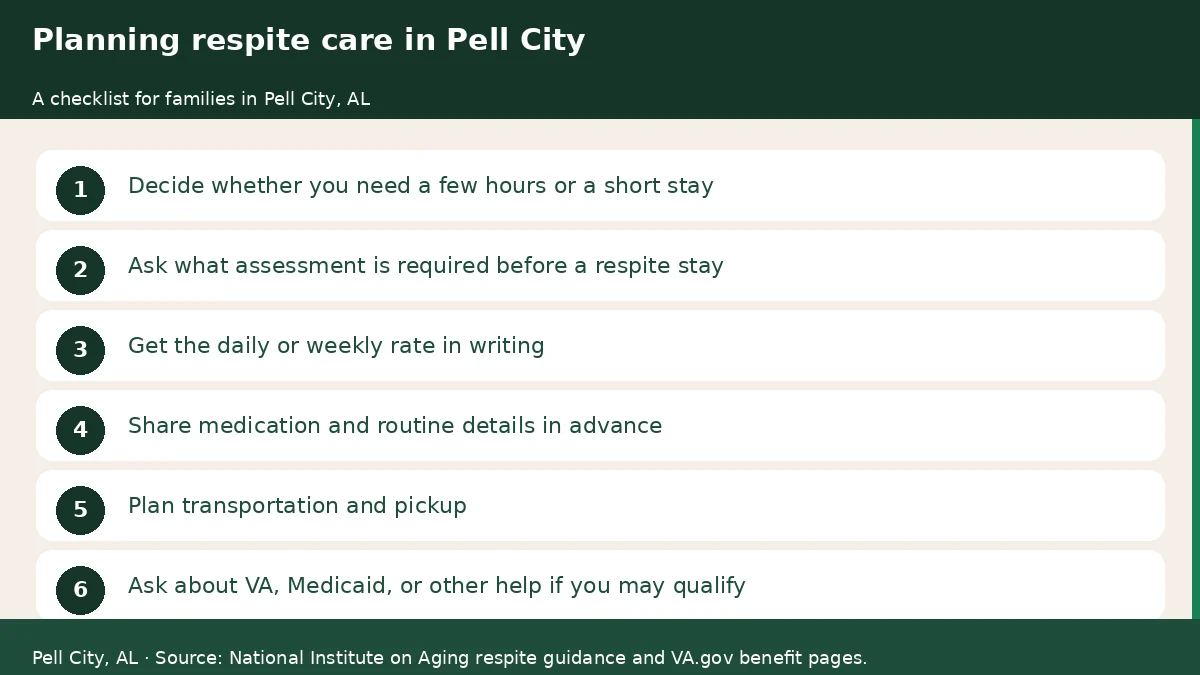
- Set the scope. Confirm the desired dates, transportation, arrival and departure arrangements, overnight needs and a backup contact. Ask about minimum stay requirements, assessment steps, deposits and cancellation terms before assuming the dates are settled.
- Describe the day. Explain waking and bedtime routines, food preferences, bathing, dressing, toileting, mobility and communication. Note which tasks require hands-on help, which require cueing and which the person prefers to do independently.
- Make health information usable. Bring an accurate medication list, prescriber and pharmacy contacts, allergy information and emergency contacts. Ask who reviews this information, how medication support works and how the setting communicates a health change.
- Discuss memory support plainly. Describe confusion, wandering or exit-seeking, agitation, sleep patterns and approaches that usually help the person feel oriented. Ask about supervision and the environment without expecting a short stay to change the underlying condition.
- Plan the handoff and follow-up. Pack familiar clothing and a few recognizable personal items, labeled as appropriate. Agree on who will provide updates, then arrange a discussion afterward about what worked, what was unclear and what should change next time.
Ask for written answers when possible. A clear scope of care protects the older adult from misunderstandings and helps the caregiver step away without continually reconstructing instructions by phone.
Using the experience to plan what comes next
After the break, review the arrangement while details are fresh. Which tasks were covered, which required extra explanation, and did the schedule actually give the caregiver time to rest? If a residential stay occurred, ask the older adult and the care team separately about routines, comfort, communication and any supervision concerns.
Keep the conclusions modest. One difficult handoff does not prove that a setting is wrong, and one smooth visit does not settle every future need. The experience can clarify whether to repeat home visits, try adult day care, request another short stay or begin a broader discussion about assisted living or memory care. A written record makes the next family conversation more specific and less dependent on crisis.
Frequently asked questions
What does respite care mean for Pell City families?
Respite care is temporary help that lets a regular family caregiver step away while an older adult receives agreed care and supervision. In the Pell City area, it may be arranged at home, through an adult day program or, where available, as a short residential stay. The schedule and setting should match the help needed. A short stay should never be assumed to be available at a particular assisted living home without asking directly.
How much should we budget for respite care near Pell City?
These are benchmarks, not provider quotes or Village East rates. Ask about minimum visits, overnight coverage, transportation and cancellation terms before setting a budget.
Does Alabama Medicaid cover respite care in Pell City?
Alabama Medicaid’s Elderly and Disabled Waiver lists respite as a home and community-based service for people who meet program requirements, including nursing facility level of care. However, it does not pay for assisted living room, board or assisted living services. That means families should not assume the waiver will cover a short residential stay in Pell City. Ask Medicaid or the assigned case manager which exact service, provider type and setting are authorized.
Does Village East offer short-term respite stays?
Village East offers assisted living and memory care at 220 Kings Circle in Pell City, but families should ask directly about short-stay availability rather than assuming respite is offered. When you call, describe the dates, overnight needs, personal care, mobility and memory support required. Ask what a stay could include, whether the desired dates are possible and what current rates apply. Also ask who reviews care needs before any stay is confirmed.
How should we prepare for a first respite stay in Pell City?
Prepare a brief written routine covering waking, meals, dressing, bathing, toileting, mobility, communication and calming preferences. Bring an accurate medication list and emergency contacts, and ask how medication support and health changes are handled. For someone with memory loss, ask about supervision, cueing and the environment without expecting a change in the condition. Familiar clothing and a few recognizable personal items can make the handoff clearer. Arrange a follow-up discussion afterward.
Talk with Village East
If you are weighing care options in Pell City, call (205) 814-4200 or request a tour. Our team can talk through current availability, rates and next steps. Please confirm all details directly, since published figures and listings change over time.
Sources
- Medicare: long-term care coverage
- Eldercare Locator (U.S. Administration for Community Living)
- National Institute on Aging: What is respite care?
- the National Institute on Aging: respite care
- ACL: What is long-term care insurance
- Alabama Medicaid: Elderly and Disabled Waiver
Program rules and benefit amounts were checked on the linked official pages in November 2026 and can change.
Related reading on this site: